Blog

  • Vietnam to U.S. GPA Conversion Guide (High School & University Grades)

    Vietnam to U.S. GPA Conversion Guide (High School & University Grades)

    This Vietnam to U.S. GPA conversion guide helps Vietnamese students understand how grades from Vietnam’s education system translate into the U.S. 4.0 GPA scale for admissions. Vietnamese schools use a 10-point grading scale, while U.S. universities evaluate applicants using GPA. Because these systems differ significantly, students must convert their grades correctly to present their academic performance clearly during undergraduate applications, graduate admissions, scholarship reviews, and credential evaluations.

    To simplify this process, MyEvaluationPal offers a reliable and easy-to-use GPA Calculator that converts Vietnamese high school and university grades into U.S. GPA equivalents using verified international grading standards. Additionally, students can explore how grading systems differ worldwide through the Global Grading Scale Database, which supports international applicants across multiple education systems. As a result, students gain a clearer and more accurate understanding of how U.S. institutions evaluate their academic records.

    Understanding the Vietnam Grading System

    Vietnam uses a 10-point grading scale across both secondary and higher education. Unlike percentage-based or GPA systems, grades are awarded as numeric scores ranging from 0 to 10, often including decimal values such as 7.5 or 8.2. Because of this structure, Vietnamese transcripts do not directly display a GPA, making conversion essential for U.S. admissions.

    Vietnamese academic evaluation is overseen by the Ministry of Education and Training (MOET) and applies to:

    • Upper Secondary Education (High School)

    • Undergraduate University Programs

    • Graduate-Level Studies

    Although grading standards may vary slightly by institution, the 10-point scale remains consistent nationwide. Consequently, accurate conversion requires a standardized equivalency method rather than a simple percentage calculation.

    Vietnam 10-Point Scale to U.S. GPA Conversion

    Below is a commonly used Vietnam to U.S. GPA conversion table applied by international admissions offices and credential evaluators:

    Vietnam Grade (10-Point Scale) U.S. GPA U.S. Letter Grade U.S. Letter Grade
    9.0 – 10.0 4 A A
    8.5 – 8.9 3.7 A– A–
    8.0 – 8.4 3.3 B+ B+
    7.0 – 7.9 3 B B
    6.5 – 6.9 2.7 B– B–
    6.0 – 6.4 2.3 C+ C+
    5.0 – 5.9 2 C C
    Below 5.0 0.0 – 1.0 F / D D
    Below 33% Fail 0 F

    This conversion helps U.S. institutions accurately compare Vietnamese applicants with domestic and other international students.

    Vietnam High School Grades to U.S. GPA Conversion

    Vietnamese high school students applying to U.S. colleges or universities must convert their final upper secondary grades into a U.S. GPA format. Since Vietnamese transcripts typically list subject scores on the 10-point scale, GPA conversion ensures that admissions officers can interpret academic performance consistently.

    Using the MyEvaluationPal GPA Calculator, students can enter:

    • Individual subject grades

    • Country selection as Vietnam

    • Education level as High School

    The calculator then converts each grade into its U.S. GPA equivalent and produces an overall GPA on the 4.0 scale, ready for use in applications.

    Vietnamese student reviewing academic transcripts and preparing documents for U.S. university admission and GPA conversion.
    A Vietnamese student preparing academic records for U.S. university admission and GPA conversion.

    Vietnam University GPA Conversion to the U.S. System

    At the university level, Vietnamese institutions may present results as course averages, credit-weighted scores, or final cumulative grades on the 10-point scale. However, U.S. universities require a GPA-based evaluation to determine academic standing, transfer credit eligibility, and program competitiveness.

    Through MyEvaluationPal, university students can:

    • Enter course-by-course grades

    • Include credit hours where applicable

    • Automatically receive a converted U.S. GPA

    This process ensures that Vietnamese university grades are translated accurately and consistently for U.S. admissions and credential evaluations.

    Example: Vietnam Grades Converted to U.S. GPA

    Consider a realistic example of a Vietnamese student’s academic record:

    • Mathematics: 8.6 → 3.7 GPA (A–)

    • Physics: 8.2 → 3.3 GPA (B+)

    • Chemistry: 7.8 → 3.0 GPA (B)

    • English: 8.9 → 3.7 GPA (A–)

    • Overall Average: 8.4 → 3.3–3.7 GPA range

    Although the original transcript does not list a GPA, proper conversion clearly shows the student’s academic strength in a format recognized by U.S. institutions.

    How the GPA Calculator Works for Vietnam Students

    The MyEvaluationPal GPA Calculator is built specifically to support international applicants from Vietnam.

    Step 1: Enter Academic Records

    Students input subject names and grades using the 10-point scale.

    Step 2: Select Vietnam as the Country

    This activates Vietnam-specific conversion logic.

    Step 3: Automatic GPA Conversion

    Grades are instantly converted into the U.S. 4.0 GPA scale using verified equivalency standards.

    Step 4: Download a Professional GPA Report

    Students receive a downloadable PDF showing:

    • Original Vietnam grades

    • Converted U.S. GPA

    • Clean, professional formatting

    This report can be used for:

    • U.S. university admissions

    • International credential evaluations

    • Scholarship applications

    • Transfer credit review

    Why GPA Conversion Matters for Vietnam Students Applying to the U.S.

    U.S. institutions rely heavily on GPA to assess:

    • Academic readiness

    • Program eligibility

    • Scholarship qualification

    • Transfer credit decisions

    • International transcript evaluation

    Because Vietnam’s grading system differs significantly from the U.S. GPA model, failing to convert grades accurately can lead to misunderstanding or undervaluation of academic performance. Therefore, GPA conversion is a critical step for Vietnamese students seeking fair consideration in U.S. admissions.

    Convert Vietnam Grades to U.S. GPA with Confidence

    Understanding how Vietnam’s 10-point grading system converts to the U.S. GPA scale is essential for students planning to study in the United States. With the MyEvaluationPal GPA Calculator and a verified grading scale database, students can convert their academic records accurately and confidently.

    Whether you are applying to high school transfer programs, undergraduate degrees, graduate studies, or scholarship opportunities, a correct GPA conversion ensures your academic achievements are evaluated fairly and professionally within the U.S. education system.

    Students are encouraged to explore the Grading Scale Database or reach out via the Contact Page for additional assistance.

  • Philippines to USA GPA Conversion Guide

    Philippines to USA GPA Conversion Guide

    Planning to study in the United States from the Philippines? One of the most important steps is understanding how your grades translate into the US GPA system. This guide will help you convert your Philippine grades to the US 4.0 scale accurately, understand how US universities evaluate international students, and give you practical tips to present your GPA in the best light.

    Whether you’re applying for undergraduate studies, graduate programs, or scholarships, knowing how your grades compare can make a huge difference in your application.

    Why GPA Conversion Matters for Filipino Students?

    Many Filipino students assume that their grades will be automatically understood by US universities, but that’s rarely the case. GPA conversion is crucial for several reasons:

    • Admission Decisions: US universities rely heavily on GPA as a measure of academic performance. A misinterpreted GPA can hurt your chances.

    • Scholarships and Financial Aid: Many scholarship programs have GPA thresholds. Understanding your converted GPA ensures you apply to opportunities you are eligible for.

    • Graduate Programs: For master’s or PhD programs, your GPA can determine whether you qualify for the program or need to improve other parts of your application.

    Understanding the Philippine Grading System

    Before converting your GPA, it’s important to understand how grades work in the Philippines. Philippine schools typically use one of these systems:

    1. 1.0 to 5.0 Scale: 1.0 is the highest grade, 5.0 is failing. This is common in universities like UP (University of the Philippines).

    2. Percentage / 100-Point Scale: Many colleges and high schools use percentages. For example, 90-100% is excellent, 75% is passing.

    3. Letter Grades: Less common, but some institutions use A, B, C, etc., similar to the US system.

    Example of a 1-5 scale conversion to percentage:

    Philippine Grade Equivalent Percentage Remark
    1.0 95–100% Excellent
    1.5 90–94% Very Good
    2.0 85–89% Good
    2.5 80–84% Above Average
    3.0 75–79% Satisfactory
    5.0 Below 75% Failing

    How does the USA GPA System Work?

    In the United States, GPA (Grade Point Average) is a standardized way of measuring academic performance. Most US schools and universities use a 4.0 scale, where 4.0 is the highest possible GPA. Understanding how this system works is essential before converting your Philippine grades.

    The 4.0 Scale Explained

    • 4.0 GPA – Excellent or A

    • 3.0 GPA – Good or B

    • 2.0 GPA – Satisfactory or C

    • 1.0 GPA – Poor or D

    • 0.0 GPA – Failing

    Weighted vs Unweighted GPA

    • Unweighted GPA: Only the grade counts, regardless of course difficulty. Example: An A in a regular course = 4.0, an A in an advanced course = 4.0 as well.

    • Weighted GPA: Takes course difficulty into account. Advanced Placement (AP), honors, or IB courses may give extra points. Example: An A in an AP course could be 5.0 instead of 4.0.

    Letter Grades and GPA Correspondence

    US universities often report GPA alongside letter grades. Here’s a simple reference:

    Letter Grade GPA Value Remarks
    A 4.0 Excellent
    A- 3.7 Very Good
    B+ 3.3 Good
    B 3.0 Above Average
    B- 2.7 Slightly Above Average
    C+ 2.3 Average
    C 2.0 Satisfactory
    D 1.0 Poor
    F 0.0 Failing

    How US Universities Interpret International Grades?

    US universities do not just “see a number”; they often consider:

    • Your home country grading system

    • Course difficulty

    • Class rank (if available)

    • Academic trends (improving grades over time)

    Step-by-Step Philippines to USA GPA Conversion

    Converting your Philippine grades to the US GPA system may seem tricky at first, but once you understand the process, it becomes straightforward. Here’s a step-by-step guide that Filipino students can use to accurately calculate their GPA on a US 4.0 scale.

    1. Identify Your Philippine Grading System

    Before converting, know which grading system your school uses:

    • 1.0–5.0 scale (1.0 is highest)

    • Percentage / 100-point scale

    • Letter grades (A, B, C, etc.)

    2. Convert Philippine Grades to Percentage (if needed)

    If your school uses the 1.0–5.0 GPA scale, convert it to a percentage to make the next step easier.

    Example Conversion Table (1–5 scale to %):

    Philippine Grade Percentage Range Remark
    1.0 95–100% Excellent
    1.5 90–94% Very Good
    2.0 85–89% Good
    2.5 80–84% Above Average
    3.0 75–79% Satisfactory
    5.0 Below 75% Failing

    3. Use the US GPA Conversion Formula

    Once you have your grades in percentage, you can map them to the US 4.0 scale. Here’s a commonly used conversion:

    Philippine Percentage US GPA
    95–100% 4.0
    90–94% 3.7
    85–89% 3.3
    80–84% 3.0
    75–79% 2.7
    Below 75% 0–2.0

    4. Calculate Your Overall GPA

    To find your cumulative GPA:

    1. Multiply the US GPA equivalent of each subject by its credit/unit value

    2. Sum up all grade points

    3. Divide by the total number of credits/units

    Formula:

    GPA

    Subject PH Grade % Equivalent US GPA Credits Grade Points × Credits
    Math 1.5 92% 3.7 3 11.1
    English 2.0 87% 3.3 3 9.9
    History 1.0 97% 4.0 3 12.0

    Cumulative GPA = (11.1 + 9.9 + 12.0) ÷ 9 = 3.67

    5. Tips for Accurate Reporting

    • Round wisely: US schools usually accept two decimal places.

    • Include a grade scale explanation: Always mention your home country grading system in applications.

    • Use professional evaluation for official purposes: Services like WES or ECE can validate your GPA for US admissions.

    Online Tools and Credential Evaluation Services

    Converting your Philippine grades to a US GPA can be done manually, but online tools make the process faster, easier, and more accurate. For Filipino students planning to study in the USA, using a trusted GPA calculator ensures you get reliable results without the stress of manual calculations.

    1. Use an Online GPA Calculator

    An online GPA calculator simplifies the conversion process:

    • Enter your Philippine grades (percentage or scale-based).

    • Specify your course credits or units.

    • The calculator automatically converts your grades to the US 4.0 GPA scale.

    • Get your cumulative GPA instantly.

    2. Professional Credential Evaluation

    While online calculators are perfect for personal use and planning, universities may require an official evaluation of your grades. This ensures that your academic performance is recognized and understood correctly by admissions offices.

    Key Benefits of Professional Evaluation:

    • Confirms your GPA conversion is accurate according to US standards.

    • Provides a documented report you can submit with applications.

    • Helps with scholarships, job applications, or program requirements.

    3. How to Decide Which Method to Use?

    • Personal Planning: Use your free GPA calculator to check your scores, track progress, or plan for improvement.

    • Official Submission: Use professional evaluation only if the university or program explicitly requires it.

    • Best Approach: Start with the calculator to estimate your GPA, then get an official evaluation when needed for submission.

    Tip: Our Free GPA Calculator allows you to convert your Philippine grades to a US GPA instantly, making it perfect for students who want a quick and reliable estimate before applying to US colleges or universities.

    Tips to Improve Your GPA for US Applications

    Your GPA plays a significant role in US college or university admissions. Even if your grades are already strong, there are ways to maximize your academic profile and make your application more competitive. Here’s how Filipino students can improve or present their GPA effectively:

    1. Focus on Key Subjects

    • Identify courses that are most relevant to your intended US program.

    • Excelling in these subjects can demonstrate your academic strengths, even if other grades are average.

    • For example, if you’re applying for engineering, prioritize math, physics, and related courses.

    2. Highlight High-Performance Trends

    • US universities often consider academic trends, not just overall GPA.

    • If your grades improved over time, make sure to showcase this upward trend.

    • A rising GPA trend indicates growth and resilience, which admissions officers value.

    3. Take Advantage of Honors or Advanced Classes

    • If your school offers honors or advanced courses, performing well in these can boost your profile.

    • Even if your cumulative GPA isn’t perfect, excelling in challenging courses signals academic rigor.

    4. Use Your GPA Strategically in Applications

    • Include a grade scale explanation: clarify your home country’s grading system.

    • If your GPA is lower than typical US requirements, highlight other strengths: standardized test scores, projects, or extracurriculars.

    5. Track Your GPA Accurately

    • Use tools like our Free GPA Calculator to monitor your progress semester by semester.

    • Accurate tracking helps you plan improvement strategies and focus on courses that matter most.

    6. Don’t Forget Holistic Factors

    • GPA is important, but US admissions also consider essays, recommendation letters, and extracurricular achievements.

    • A slightly lower GPA can be balanced with strong projects, leadership roles, or research experience.

    Frequently Asked Questions

    What is the equivalent of a 1.5 in the Philippines on the US GPA scale?

    A 1.5 in the Philippine 1.0–5.0 scale is typically equivalent to 3.7 on the US 4.0 GPA scale. This is considered a very good grade and demonstrates strong academic performance.

    Do all US universities accept converted GPA from the Philippines?

    Most US universities accept GPA conversions from the Philippines, but the method may vary. Always provide a grade scale explanation with your application to ensure your GPA is interpreted correctly.

    Can graduate programs require a different GPA conversion method?

    Yes. Some graduate programs may evaluate international grades differently, focusing on course rigor, trends, and relevance. Using a GPA calculator helps estimate your score, but always check the program’s requirements.

    Can I calculate my GPA myself, or do I need a professional evaluation?

    You can calculate your GPA manually or use a trusted online tool like our Free GPA Calculator. Professional evaluation is only necessary if the university explicitly requires it for submission.

    How important is GPA compared to other admission factors?

    GPA is very important, but US universities also consider essays, recommendation letters, standardized test scores, and extracurriculars. A strong overall profile can sometimes offset a lower GPA.

    What should I include when submitting my GPA to US universities?

    • Your cumulative GPA on the 4.0 scale

    • Grade scale explanation of your Philippine school

    • Optional: transcript details or course breakdowns

  • Pakistan to U.S. GPA Conversion Guide (SSC, HSSC & University Marks)

    Pakistan to U.S. GPA Conversion Guide (SSC, HSSC & University Marks)

    This Pakistan to U.S. GPA conversion guide is designed to help students with SSC, HSSC, and university qualifications clearly understand how their Pakistani academic results convert into the U.S. 4.0 GPA scale for admissions. In Pakistan, students typically receive percentage-based marks and division classifications; however, U.S. universities assess applicants using a standardized GPA system. Because of this fundamental difference, accurate GPA conversion therefore becomes essential for fair evaluation during college admissions, graduate school applications, scholarship reviews, and credential assessments.

    To simplify this process, MyEvaluationPal provides a reliable and easy-to-use GPA Calculator that converts Pakistani SSC, HSSC, and university marks into their U.S. GPA equivalents using verified international grading standards. In addition, students can explore how grading works across different countries by using the Global Grading Scale Database, which is specifically built to support international applicants worldwide. As a result, students gain a clearer understanding of how their academic performance compares globally.

    Illustration showing Pakistani SSC and HSSC students preparing documents for U.S. university admission with GPA conversion from Pakistan to U.S. 4.0 scale.
    Pakistani SSC and HSSC students converting their academic records to the U.S. 4.0 GPA scale for university admissions.

    Understanding the Pakistan Grading System

    Pakistan follows a percentage-based academic grading system governed primarily by the Boards of Intermediate and Secondary Education (BISE), the Federal Board (FBISE), and provincial education boards in Punjab, Sindh, Khyber Pakhtunkhwa, and Balochistan. Unlike the GPA-based systems used in the U.S., Pakistani students receive marks out of 1100, along with division rankings that summarize overall academic performance. Consequently, students must rely on GPA conversion tools when applying abroad.

    The two most important academic levels for international applicants, therefore, include:

    • SSC (Secondary School Certificate) – Class 9 and Class 10

    • HSSC (Higher Secondary School Certificate) – Class 11 and Class 12

    Moreover, results are classified into divisions as follows:

    • First Division: 60% and above

    • Second Division: 45%–59%

    • Third Division: 33%–44%

    • Fail: Below 33%

    Since U.S. institutions do not evaluate students based on divisions alone, these results must be translated into a U.S. GPA equivalent in order to ensure an accurate and fair academic comparison during admissions. As a result, GPA conversion becomes a critical step for Pakistani students planning to study in the United States.

    Pakistan Percentage to U.S. GPA Conversion Table

    Below is the most commonly accepted Pakistan percentage to U.S. GPA conversion scale used by credential evaluators and international admissions offices:

    Pakistan Percentage Division U.S. GPA U.S. Letter Grade
    85–100% First 4 A
    75–84% First 3.7 A–
    65–74% First 3.3 B+
    60–64% First 3 B
    55–59% Second 2.7 B–
    50–54% Second 2.3 C+
    45–49% Second 2 C
    33–44% Third 1.0–1.7 D
    Below 33% Fail 0 F

    This conversion table helps U.S. admissions officers compare Pakistani applicants fairly with domestic and other international students.

    Pakistan SSC and HSSC to U.S. GPA Conversion

    Students who complete SSC (Matric) and HSSC (Intermediate, FSc, ICS, FA) programs must convert their results into GPA format before applying to:

    • U.S. colleges and universities

    • Community colleges and transfer programs

    • Undergraduate and graduate-level degrees

    • International scholarship programs

    Using the MyEvaluationPal GPA Calculator, students can simply enter:

    • Subject-wise marks

    • Total marks

    • Country selection as Pakistan

    • Education level as SSC, HSSC, or University

    The system then instantly converts all grades into the U.S. 4.0 GPA scale, eliminating confusion and guesswork.

    Example: Pakistan HSSC to U.S. GPA Conversion

    Below is a realistic example based on a typical HSSC Science/ICS transcript:

    • English: 159/200 → approximately 79.5% → 3.7 GPA (A–)

    • Mathematics: 176/200 → 88% → 4.0 GPA (A)

    • Physics: 172/200 → 86% → 4.0 GPA (A)

    • Computer Science: 185/200 → 92.5% → 4.0 GPA (A)

    • Overall Total: 907/1100 → approximately 82.5% → 3.7–4.0 GPA range

    This example clearly shows that even though Pakistani transcripts do not list GPA directly, percentage-based grades can be accurately converted into U.S. GPA values using verified conversion logic.

    How the GPA Calculator Works for Pakistan Students

    The MyEvaluationPal GPA Calculator is designed specifically to support international students applying to U.S. institutions.

    Step 1: Enter Subject-Wise Marks

    Students enter all SSC, HSSC, or university subjects along with total marks and obtained marks.

    Step 2: Select Pakistan as the Country

    Choosing Pakistan ensures the correct national grading logic is applied during conversion.

    Step 3: Automatic Conversion to U.S. GPA

    The system instantly converts all grades into the U.S. 4.0 GPA scale using verified equivalency standards.

    Step 4: Download Official GPA Report

    Students receive a professional downloadable PDF that includes:

    • Original Pakistani marks

    • U.S. GPA equivalents

    • Weighted and unweighted GPA

    • Clean, official presentation for admissions

    This GPA report is suitable for:

    • U.S. university admissions

    • International student visa cases

    • Credential evaluation agencies such as WES, ECE, and NACES

    • Scholarship and transfer credit review

    Why GPA Conversion Matters for Pakistani Students Applying to the U.S.

    U.S. universities rely heavily on GPA as a standardized academic indicator for:

    • Undergraduate and graduate admissions

    • Financial aid and stipend eligibility

    • Transfer credit evaluation

    • International credential assessment

    • Program competitiveness analysis

    Since Pakistani students are evaluated using percentages and divisions, failing to convert these properly can result in academic underrepresentation. A correct GPA conversion ensures that students from Pakistan are reviewed fairly within the U.S. admissions framework.

    Students can also explore conversion systems for other countries using these resources:

    Convert Your Pakistan Grades to U.S. GPA with Confidence

    Understanding how Pakistani SSC, HSSC, and university marks convert into the U.S. GPA system is a critical step for students planning to study abroad. With the MyEvaluationPal GPA Calculator and a verified grading scale database, students can convert their academic records with confidence, accuracy, and clarity.

    Whether you are applying for undergraduate programs, graduate school, scholarships, or credential evaluation, an accurate GPA conversion ensures that your academic performance is represented fairly and professionally within the U.S. education system.

    Students are encouraged to explore additional global grading resources in the Grading Scale Database or reach out through the Contact Page for personalized support.

  • India to U.S. GPA Conversion Guide: Convert Your Marks to the U.S. 4.0 GPA Scale Easily

    India to U.S. GPA Conversion Guide: Convert Your Marks to the U.S. 4.0 GPA Scale Easily

    If you’re an Indian student planning to study in the United States, one of the most important parts of your application is understanding how your Indian grades convert to the U.S. GPA system. India uses a mix of percentages, CBSE letter grades (A1, A2, B1, etc.), and 10-point CGPA scales, while U.S. universities almost always rely on the standardized 4.0 GPA scale. This can make the conversion confusing, especially for CBSE, ICSE, and state board students.

    To solve this, MyEvaluationPal offers a simple and accurate way to convert your India grades into a U.S.-compatible GPA format. Our trusted GPA Calculator uses verified academic equivalency tables, making it easy for students, admissions offices, and credential evaluators to interpret your academic profile correctly.

    You can also explore more grading systems on our Grading Scale Database, or visit our Home Page to learn more about conversion tools designed specifically for international applicants.

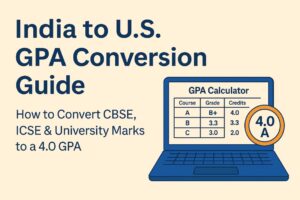
    Illustration showing a GPA calculator on a laptop with the text ‘India to U.S. GPA Conversion Guide’ and a chart converting CBSE, ICSE, and Indian university grades to the U.S. 4.0 GPA scale.
    How Indian CBSE, ICSE, and university marks convert to the U.S. 4.0 GPA scale using MyEvaluationPal’s GPA Calculator.

    India Grading Systems and How They Convert to the U.S. GPA

    India does not follow a single standardized grading system. Depending on the school board or university, students may receive:
    • Percentage scores (e.g., 86%, 72%, 59%)
    • CBSE letter grades like A1, A2, B1, B2, C1
    • ICSE and ISC marks in percentages
    • 10-point CGPA used by many colleges and universities
    • Division or class system (First Class, Distinction, etc.)

    Because of these variations, converting Indian grades into the U.S. GPA system requires a reliable, standardized method. This is exactly what our GPA Calculator provides—accurate, board-specific conversion tables using internationally recognized benchmarks.

    For example, CBSE marksheets such as those in the uploaded transcript show subject-wise Theory + Practical scores along with positional grades like A2, B1, C1, which must be matched to GPA equivalents for the U.S. 4.0 scale.

    If you’re interested in how other countries compare, you can also read our popular UK to U.S. GPA Conversion Guide to see similarities and differences.

    CBSE Grade to U.S. GPA Conversion Table

    CBSE uses a structured grading system that maps well to U.S. GPA equivalencies. Below is the widely accepted conversion:

    CBSE Grade Score Range U.S. GPA Equivalent U.S. Letter Grade
    A1 91–100% 4 A
    A2 81–90% 3.7 A–
    B1 71–80% 3.3 B+
    B2 61–70% 3 B
    C1 51–60% 2.7 B–
    C2 41–50% 2 C
    D 33–40% 1 D
    E1/E2 Below 33% 0 F

    This CBSE-to-GPA conversion is essential for CBSE Class 10 and Class 12 students applying to U.S. colleges, scholarships, or visa processes. Since U.S. universities evaluate applicants using comparable metrics, converting CBSE grades to GPA ensures your academic performance is interpreted fairly.

    To make this even easier, the conversion table is built into our GPA Calculator so students can instantly see their GPA on the U.S. scale.

    Indian Percentage to U.S. GPA Conversion

    Most Indian colleges and universities still use percentages. Since the U.S. education system does not use percentages directly, converting them to GPA is required for transcripts, credential evaluations, or graduate school admissions.

    Here’s the standard equivalency:

    Indian Percentage U.S. GPA U.S. Grade
    85–100% 4 A
    75–84% 3.7 A–
    60–74% 3.3 B+
    50–59% 2.7 B–
    40–49% 2 C
    Below 40% 0 F

    When entered into our GPA Calculator, these percentages automatically convert into U.S. GPA values through our verified equivalency table.

    10-Point CGPA to U.S. GPA Conversion

    A large number of Indian universities—especially engineering colleges and central universities—use a 10-point CGPA system instead of percentages. These scores need to be converted into GPA for applications to U.S. graduate programs, scholarships, or employment verification.

    10-Point CGPA U.S. GPA Equivalent
    9.0–10 4
    8.0–8.9 3.7
    7.0–7.9 3.3
    6.0–6.9 2.7
    5.0–5.9 2
    Below 5 0

    Our system applies this mapping automatically when students input their CGPA into the GPA Calculator.

    Sample CBSE Transcript Conversion (From Uploaded India Marksheets)

    Below are real examples from the uploaded CBSE Class 10 and Class 12 transcripts to illustrate conversion:

    Class 10 Example

    • English: A2 (87 marks) → U.S. GPA 3.7

    • Hindi: B1 (85 marks) → U.S. GPA 3.3

    • Maths: B2 (67 marks) → U.S. GPA 3.0

    • Punjabi: A2 (92 marks) → U.S. GPA 3.7

    Class 12 Example

    • English Core: A2 (88 marks) → U.S. GPA 3.7

    • Physics: C1 (64 marks) → GPA 2.7

    • Chemistry: B1 (75 marks) → GPA 3.3

    • Mathematics: B2/C2 range (58 marks) → GPA 2.0–3.0

    These subject-specific conversions help admissions officers evaluate your academic strengths accurately when reviewing transcripts.

    How the GPA Calculator Works for Indian Students

    Our conversion process is built to be simple, transparent, and accurate. Here’s how the GPA Calculator works for CBSE, ICSE, and university students:

    STEP 1: Enter Your Grades or Marks

    You can enter CBSE grades (A1, A2, B1), ICSE percentages, or university CGPA.

    STEP 2: Select India and Your Board/University

    Choosing the correct board ensures the right conversion table is applied.

    STEP 3: Automatic Grade Conversion

    The system instantly matches your grades to the U.S. 4.0 GPA scale using internationally recognized equivalency data.

    STEP 4: Download Your Official GPA Report

    You receive a downloadable PDF showing:

    • Original grades

    • U.S. GPA equivalents

    • Weighted and unweighted GPA

    This report is extremely useful for applications to universities, graduate programs, scholarships, and credential evaluation services.

    Try it here: GPA Calculator

    Why GPA Conversion Matters for Indian Students Applying to U.S. Universities

    U.S. universities expect a transparent academic summary that fits their evaluation standards. Because Indian marksheets vary widely (CBSE, ICSE, State Boards, universities), GPA conversion is essential for:

    • Admissions review

    • Scholarship consideration

    • Visa applications

    • Transfer applications

    • Graduate program requirements

    • Credential evaluations (WES, ECE, etc.)

    Accurate GPA conversion increases your chances of receiving fair and competitive consideration during admission.

    For more global grading systems, visit our Grading Scale Database.

    Convert Your India Marks to U.S. GPA in Minutes

    With multiple grading patterns across India, understanding how your marks translate into the U.S. GPA system can be overwhelming. However, using the MyEvaluationPal GPA Calculator makes the process quick, accurate, and stress-free. Whether you’re applying to undergraduate programs, graduate schools, scholarships, or international jobs, a properly converted GPA ensures that your academic achievements are evaluated correctly.

    Explore global grading scales using our Grading Scale Database or reach out through our Contact Page if you need assistance.


  • US Grading System Tool: Convert Grades, Understand GPA, and College Requirements

    US Grading System Tool: Convert Grades, Understand GPA, and College Requirements

    For students, parents, and international applicants, understanding how grades translate into the U.S. grading system can be confusing. Every school seems to have its own standards, and international transcripts make things even more complex. That’s why a US grading system tool is so valuable—it allows you to instantly convert percentages or letter grades into the familiar 4.0 GPA scale used across American colleges and universities.

    This guide will not only show you how to use such a tool but will also answer the most common questions about grades, GPA conversions, and what top universities really expect. Whether you’re aiming for Harvard, UCLA, or simply want to check if your 70% is good enough, you’ll find clear answers here.

    Try our free US Grading System Tool (GPA Calculator) to see how your grades convert instantly.

    What Is the US Grading System?

    The U.S. grading system is built on letter grades (A–F), percentages, and GPA (Grade Point Average). Most schools and universities combine all three to assess academic performance.

    • Letter Grades – A (excellent) through F (failing).

    • Percentages – Usually tied to the letter scale (for example, 90–100% = A).

    • GPA Scale – A 0.0–4.0 system used to calculate an overall average of all coursework.

    Here’s a standard breakdown of the U.S. grading scale:

    Percentage

    Letter Grade

    GPA (4.0 Scale)

    Meaning

    90–100%

    A

    4.0

    Excellent

    80–89%

    B

    3.0

    Good

    70–79%

    C

    2.0

    Average

    60–69%

    D

    1.0

    Below Average

    < 60%

    F

    0.0

    Failing

    With a US grading system tool, you don’t have to guess. Simply enter your percentage or letter grade, and you’ll instantly see the equivalent GPA on a 4.0 scale.

    US Grading System Tool – Instantly Convert Your Grades

    Manually converting grades into a U.S. GPA scale can be tricky, especially if you’re coming from a different education system. That’s where a US grading system tool makes things simple. Instead of memorizing charts or calculating by hand, you can enter your score and instantly see the equivalent GPA and letter grade.

    Here’s how it works in practice:

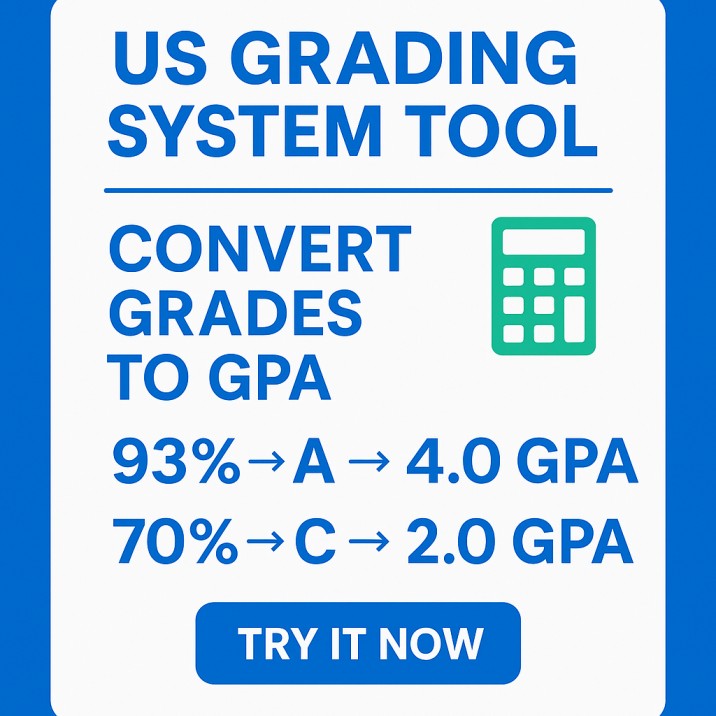
    • Example 1: 93% → A → 4.0 GPA

    • Example 2: 70% → C → 2.0 GPA

    • Example 3: 85% → B → 3.0 GPA

    This quick conversion saves time and removes confusion, especially for:

    • High school students tracking GPA for college applications

    • International students converting transcripts for admissions

    • Parents and counselors supporting students through the process

    Try our US Grading System Tool (Free GPA Calculator) to test it yourself and see exactly how your scores convert.

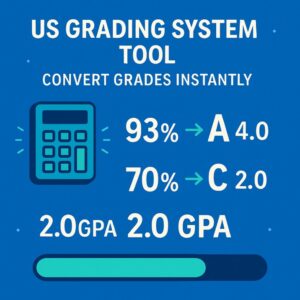
    US grading system tool graphic with calculator icon, grade-to-GPA conversions, and progress bar design.
    Illustrated guide showing how the US grading system tool converts percentages like 93% and 70% into GPA.

    GPA Conversion Examples (US Grading System Tool in Action)

    Understanding how percentages translate into letter grades and GPA can be confusing. To make it easier, here are clear conversion examples using the US grading system tool.

    Percentage-to-GPA Conversion Table

    Percentage

    Letter Grade

    GPA (4.0 Scale)

    Meaning

    97–100%

    A+

    4.0

    Outstanding

    93–96%

    A

    4.0

    Excellent

    90–92%

    A–

    3.7

    Very Good

    87–89%

    B+

    3.3

    Good Plus

    83–86%

    B

    3.0

    Good

    80–82%

    B–

    2.7

    Above Average

    77–79%

    C+

    2.3

    Slightly Above Avg

    73–76%

    C

    2.0

    Average

    70–72%

    C–

    1.7

    Below Average

    67–69%

    D+

    1.3

    Poor Plus

    63–66%

    D

    1.0

    Poor

    60–62%

    D–

    0.7

    Barely Passing

    Below 60%

    F

    0.0

    Failing

    Real-Life Conversion Examples

    • 93% average → A → 4.0 GPA

    • 85% average → B → 3.0 GPA

    • 70% average → C → 2.0 GPA

    • 65% average → D → 1.0 GPA

    • 59% average → F → 0.0 GPA

    Why Use a US Grading System Tool?

    Instead of memorizing conversion charts, a US grading system tool lets you:

    • Enter your grades and see instant GPA results.

    • Compare your GPA against U.S. admissions requirements.

    • Save time and reduce errors in applications.

    US Grading System vs. International Systems

    For international students, one of the biggest challenges is understanding how their grades compare to the U.S. scale. Education systems around the world use different grading methods—percentages, divisions, classifications, or ranks. A US grading system tool helps bridge this gap by converting grades into the familiar U.S. GPA format.

    Examples of International Equivalencies

    • India – A “First Division” (60–100%) may convert to a B or A range in the U.S. GPA system (2.7–4.0).

    • United Kingdom – A “2:1 Honours” degree typically aligns with a 3.3–3.7 GPA.

    • Mexico – A “9/10” on the Mexican scale generally converts to an A or 4.0 GPA in the U.S. system.

    • Nigeria – A “Second Class Upper” (60–69%) is often evaluated as a 3.0–3.5 GPA.

    • Nepal – A “Distinction” at 75% or above usually converts to a 3.7–4.0 GPA.

    Explore our International Grading Scale Database to see how your country’s grades align with the U.S. GPA scale.

    Why This Matters for Admissions

    • Universities rely on GPA conversions to make fair admission decisions.

    • Employers use standardized GPAs to compare international applicants.

    • Immigration offices require equivalency reports for visa or residency eligibility.

    By using a US grading system tool, you can translate your grades into a format that U.S. institutions instantly recognize. This ensures your hard work is evaluated fairly, no matter where you studied.

    The U.S. grading system may look simple at first glance, but the reality is more complex—especially for international students. Between letter grades, percentages, and GPA scales, it’s easy to get confused about what your scores really mean. That’s why having access to a US grading system tool is so valuable.

    Instead of guessing or relying on rough estimates, you can instantly convert grades, check your GPA, and see how you compare against U.S. admissions standards. Whether you’re applying to college, planning to study abroad, or simply tracking your academic progress, this tool saves time and improves accuracy.

    Try our free US Grading System Tool (GPA Calculator) today and take the guesswork out of GPA conversions.

    By using it now, you’ll walk into your next application cycle confident, prepared, and ready to showcase your achievements on a level playing field.

    Frequently Asked Questions About the US Grading System

    What grading system do the USA use?

    The United States uses a letter grade system (A–F) combined with percentages and a GPA scale (0.0–4.0). Most schools calculate GPA to provide a standardized measure of student performance.

    Is 70% an A in America?

    No. In most U.S. schools, 70% is a C, which equals roughly a 2.0 GPA. An A usually starts at 90% or above.

    Is a 93% average a 4.0 GPA?

    Yes. A 93% average typically equals an A, which converts to a 4.0 GPA on the unweighted scale. Some schools use weighted scales, where honors or AP courses can push GPA above 4.0.

    Is 70% a 2.0 GPA?

    Yes. On the standard U.S. grading scale, 70% corresponds to a C, which equals a 2.0 GPA.

    What is a 5.0 GPA?

    A 5.0 GPA comes from a weighted GPA scale. It is possible when students take advanced courses such as AP, IB, or honors classes where an A can carry extra grade points (5.0 instead of 4.0).

    Is a 3.3 GPA good?

    Yes. A 3.3 GPA equals about a B+ average, which is above the national average. It’s competitive for many colleges, though selective universities may expect higher.

    Is a 4.3 GPA good?

    Yes. A 4.3 GPA is excellent. However, it is only possible in schools using a weighted GPA system where advanced courses add extra points.

    Will Harvard accept a 3.3 GPA?

    Unlikely. Harvard typically admits students with near-perfect GPAs (often 3.9–4.0+ unweighted). A 3.3 GPA alone would not be competitive without exceptional achievements in other areas.

    Is a 3.17 GPA good in college?

    A 3.17 GPA is slightly above average and reflects a B grade. It may not be competitive for top graduate programs but is acceptable at many institutions.

    Is 4000 GPA good?

    This is a common typo or misunderstanding. U.S. GPAs are measured on a 0.0–4.0 scale (or 5.0 weighted). A 4000 GPA does not exist.

    What GPA is required for Harvard?

    Harvard does not set a minimum GPA, but admitted students usually have an unweighted GPA between 3.9 and 4.0. Strong extracurriculars, test scores, and essays are also critical.

    What is the lowest GPA a college will accept?

    It depends on the institution. Many community colleges accept GPAs as low as 2.0 or below, while competitive universities require much higher scores.

    Who has the lowest GPA in the world?

    There is no official record of the “lowest GPA in the world.” However, in the U.S., the GPA scale ranges from 0.0 to 4.0, where 0.0 represents failing grades in all courses.

    What GPA for UCLA?

    The average GPA of admitted students at UCLA is around 4.18 (weighted). Students generally need strong academics plus competitive extracurriculars.

    What college can I get into with a 2.4 GPA?

    With a 2.4 GPA, students may qualify for community colleges and less selective universities. Some schools also offer conditional admission if other application materials are strong.

    Which country accepts students with low GPA?

    Some countries have flexible admissions policies. For example:

    • Canada: Some universities accept GPAs around 2.5 with strong test scores.

    • Germany: Certain programs allow conditional admission.

    • Australia: Some universities admit students with lower GPAs if they meet other criteria.

    How to get your GPA up?

    • Retake classes with low grades.

    • Focus on earning higher grades in future courses.

    • Use tutoring or study groups.

    • Manage time better and prioritize assignments.

    • Take honors/AP classes (for weighted GPA boosts).

    What do you need to get into Ole Miss?

    The University of Mississippi (Ole Miss) typically requires at least a 2.5 GPA for freshman admission, plus standardized test scores (ACT/SAT).

    Is Ole Miss expensive?

    For in-state students, tuition is about $9,000 per year, while out-of-state students pay closer to $26,000 per year (not including housing and fees).

  • Credential Evaluation: Complete Guide to Common Questions

    Credential Evaluation: Complete Guide to Common Questions

    For students and professionals who studied outside their home country, moving abroad can feel overwhelming. One of the biggest challenges is proving that your qualifications are equivalent to the local standards of your new country. This is where credential evaluation comes in.

    A credential evaluation ensures fairness by comparing foreign degrees, diplomas, and transcripts against U.S. or international systems. Without it, universities may reject qualified applicants, employers may undervalue degrees, and licensing boards may deny professionals the chance to practice. In this detailed guide, we’ll break down the most common questions people ask about credential evaluation — including costs, timelines, providers, and practical tips.

    What is a credential evaluation?

    A credential evaluation is a professional service that reviews academic qualifications earned abroad and translates them into the equivalent standards of another country’s education system. It is not simply about translation of words but also about contextualizing academic achievement. For instance, a “First Division” grade in India, a “Distinction” in Nigeria, and an “A” in the U.S. may not look the same on paper, but evaluators standardize them into a common format like the U.S. GPA scale.

    Universities use these evaluations to make fair admissions decisions, employers use them to assess job candidates, and immigration offices rely on them to confirm eligibility for work visas or residency. A credential evaluation bridges the gap between different education systems, making it possible for global talent to be recognized consistently.

    Read more: What Are Credential Evaluation Services?

    How do I get my credential evaluation?

    Getting a credential evaluation usually involves a structured process. First, you’ll need to choose a trusted provider such as WES, ECE, or another NACES member. Some applicants also choose modern platforms like MyEvaluationPal for faster results.

    After selecting a provider, the next step is to gather your academic documents, such as diplomas, transcripts, and certificates. Many agencies require that transcripts be sent directly from your school or university to prevent tampering. Once documents are received, you’ll pay the fee and wait for the evaluation process to be completed.

    Tip: Before applying, confirm whether your target university, employer, or licensing board requires a specific provider. For example, some U.S. state licensing boards only accept evaluations from NACES members.

    How much does a credential evaluation cost?

    The cost depends largely on the type of evaluation you need and which provider you choose. On average:

    • Document-by-Document reports: $100–$150

    • Course-by-Course reports: $200–$300+

    • Specialized professional evaluations: May cost more depending on complexity

    Additional costs may apply for rush service, sealed copies, or mailing extra reports to universities and employers. For instance, WES charges additional fees per copy if you want multiple institutions to receive your report.

    Try our free tool: GPA Calculator to understand how your grades may convert before investing in a full evaluation.

    Which credential evaluation service is the best?

    There is no one-size-fits-all answer because the best provider depends on your purpose:

    • WES: Widely recognized by U.S. and Canadian universities. It’s often the first choice for international students applying to higher education.

    • ECE: Known for detailed course analysis, often preferred by professional licensing boards.

    • NCEES: Specialized in evaluating engineering and surveying credentials.

    • MyEvaluationPal: A modern platform offering AI-driven evaluations, transparent GPA conversions, and a global grading scale database for institutions.

    Pro tip: Always check with your university, employer, or board before choosing. Some accept any NACES member, while others specify one provider.

    Which is better, WES or ECE?

    Both WES and ECE are respected members of NACES, and both offer reliable evaluations. The difference often comes down to acceptance and detail.

    • WES is typically the safer choice for university admissions because it’s widely requested.

    • ECE is often favored by professional boards for its thorough course-by-course breakdowns.

    If you’re applying for graduate programs, WES may be better. If you’re applying for professional licensure (like nursing or teaching), ECE might be the right choice.

    How much does a NACES evaluation cost?

    Since NACES is an association and not a direct provider, fees vary depending on the agency you choose. For example:

    • WES: Around $220 for a standard course-by-course evaluation.

    • ECE: Between $195–$245 depending on the service.

    Expect an average cost of $150–$300 for most NACES-approved evaluations.

    Is NACES worth it?

    Yes. Many institutions specifically require evaluations from NACES-approved providers because NACES members must follow strict quality standards. Using a non-NACES provider could result in your report being rejected, which means wasted money and time.

    Check the full list of NACES members here.

    How long does a NACES evaluation take?

    Processing times depend on the provider and time of year.

    • Standard timeline: 2–4 weeks

    • Rush services: Available with extra fees (sometimes within 5–7 business days)

    During peak admissions seasons (like January or August), processing may take longer. MyEvaluationPal, by contrast, offers AI-powered evaluations that can process GPA conversions instantly, helping students meet urgent deadlines.

    Is WES under NACES?

    Yes. WES (World Education Services) is a founding member of NACES and one of the most widely trusted evaluation providers worldwide. This means reports from WES are almost always accepted by universities, employers, and government bodies across North America.

    How do I validate my Mexican degree in the USA?

    To validate your Mexican degree in the U.S.:

    1. Choose a credential evaluation service (preferably a NACES member).

    2. Submit your transcripts and diplomas for review.

    3. Receive a report confirming its U.S. equivalency.

    For example, a Mexican Licenciatura may be evaluated as equivalent to a U.S. bachelor’s degree. The evaluation ensures that your qualifications are recognized by universities, employers, and immigration offices.

    Can I use my Mexican high school diploma in the USA?

    Yes, but it must first go through credential evaluation. Universities and employers often require a report that confirms the diploma is equivalent to a U.S. high school diploma. Without this, your application may be delayed or rejected.

    What is the equivalent of an Indian degree in the USA?

    Equivalency depends on the program and institution. For instance:

    • A 3-year Indian bachelor’s degree may be considered less than a U.S. bachelor’s, though some universities accept it as equivalent.

    • An Indian Master’s degree from a recognized university is generally accepted as equivalent to a U.S. Master’s.

    See how Indian grades align with U.S. GPAs using our Grading Scale Database.

    What are the types and steps of evaluation?

    Types of Credential Evaluation:

    1. Document-by-Document Evaluation: Confirms degree level and institution recognition.

    2. Course-by-Course Evaluation: Detailed analysis of each subject, grade, and credit.

    3. Professional Evaluations: Required for fields like healthcare, law, and engineering.

    4. Immigration Evaluations: Tailored for visa or residency applications.

    Steps of Credential Evaluation:

    1. Choose your evaluator.

    2. Collect and submit documents.

    3. Verification by the provider.

    4. Grade and credit conversion.

    5. Receive official report.

    Credential evaluation is the key to unlocking global opportunities in education, work, and immigration. It ensures that degrees from Mexico, India, Nigeria, and beyond are fairly recognized in the U.S. or other countries. While trusted NACES members like WES and ECE remain industry standards, modern solutions like MyEvaluationPal offer faster, affordable, and more transparent alternatives.

    Start today with our free GPA Calculator and Grading Scale Database to prepare for your credential evaluation journey.

  • How Much Does Attendance Affect Your GPA?

    How Much Does Attendance Affect Your GPA?

    If you want to maintain a strong GPA, you might think the key is simply studying hard and acing your exams. However, one often-overlooked factor can quietly influence your academic performance: attendance. Whether you are a high school student, a college freshman, or an international applicant preparing transcripts, the connection between class attendance and GPA is stronger than many realize.

    While attendance might not always be directly factored into your GPA calculation, poor attendance indirectly impacts your grades. Missing lectures, skipping participation, incomplete assignments, and reduced understanding can quickly cause your grades to slip. Students who miss more classes often struggle to keep up, fall behind in coursework, and underperform on exams, even if they are capable.

    Let’s explore how skipping class can hurt your academic standing, whether it directly lowers your GPA, and if colleges care about your attendance record.

    Does Attendance Directly Affect GPA?

    In most schools and universities, attendance is not directly included in the GPA calculation. You typically will not lose GPA points just for missing class. However, attendance remains important because students who attend classes regularly tend to perform better on tests, quizzes, and assignments, all of which directly affect GPA.

    Some schools, especially in certain courses like humanities, labs, or discussion-based classes, tie attendance to your grade through participation scores. Professors may deduct points or lower your final grade if you have too many unexcused absences. This is common in colleges where attendance is tracked carefully.

    Even if it’s not an official policy, missing class means missing important explanations, pop quizzes, group discussions, or assignment details, all of which can lower your academic performance. So, while attendance might not appear on your transcript, its ripple effect often impacts your GPA.

    How Skipping Class Impacts Academic Performance?

    Skipping class occasionally might seem harmless, but frequent absences can lead to serious academic consequences.

    • Missing Content and Context: Professors often explain concepts in class that aren’t fully covered in textbooks. They also give hints about exams and clarify assignments. Missing these insights can make it harder to understand the material.

    • Lower Grades: Poor attendance often leads to lower quiz scores, missed deadlines, incomplete assignments, and poor participation grades, all of which lower your GPA.

    • Fewer Relationships: Regular attendance helps build relationships with professors and classmates, which is crucial for group work, networking, and recommendation letters.

    In short, even if attendance is not graded directly, it plays a huge indirect role in your academic success and GPA.

    Schools Where Attendance Is Graded or Mandatory

    In many institutions—especially in the U.S.—attendance is more than just encouraged; it is a formal part of your grade.

    • Attendance as Grade Percentage: Some schools allocate a portion of the final grade (sometimes 10% or more) to attendance and participation.

    • Courses That Emphasize Attendance: Seminars, language classes, labs, and discussion-based courses often have strict attendance policies.

    • Consequences of Absences: Missing multiple classes can reduce participation points, cause missed quizzes, or impact instructor evaluations.

    For international students, attendance may also affect visa compliance. Excessive absences could lead to academic warnings, loss of scholarships, or even failing a course automatically.

    The Link Between Attendance and GPA Trends

    Research consistently shows a strong connection between regular attendance and higher GPAs.

    • Students who attend regularly perform better on exams and submit assignments on time.

    • Subjects that build on previous lessons, like math, science, and languages, are especially affected by absences.

    • Being present allows for real-time interaction, immediate clarification, and participation, all of which improve understanding.

    • Regular attendance also helps you build rapport with instructors, facilitating feedback, academic support, and recommendation letters.

    Making attendance a priority is one of the simplest and most effective ways to maintain or raise your GPA.

    Do Attendance Policies Vary by School or Country?

    Yes, attendance policies differ widely:

    • In the United States, many schools require mandatory attendance, especially in participation-heavy or lab courses.

    • In countries like India or parts of Europe, universities often require a minimum attendance percentage (e.g., 75%) to sit for final exams.

    • Some online or flexible learning programs may not enforce strict attendance, focusing instead on assignments and test scores.

    Understanding your school’s attendance rules from the start is crucial. Ignoring them can hurt your GPA and delay graduation. International students should especially pay attention to adapting to new attendance expectations.

    What Happens When You Miss Too Many Classes?

    Missing too many classes can have serious academic and administrative consequences:

    • Loss of participation points or missed graded work.

    • Ineligibility to take final exams.

    • Automatic grade reduction or failing the course.

    • Required to repeat the course, which delays graduation and increases costs.

    • Academic warnings or requirements for documentation, especially for international students.

    Skipping classes doesn’t just lower your grades; it can complicate your academic journey in unexpected ways.

    How to Improve Attendance and Stay on Track?

    Improving attendance involves building habits and setting priorities:

    • Create a consistent daily routine with fixed wake-up times and study periods.

    • Use digital calendars and reminders for classes, assignments, and deadlines.

    • Avoid overcommitting to work or extracurriculars that interfere with attendance.

    • Apply time management techniques like batching tasks or the Pomodoro Technique.

    • Communicate with professors or advisors if you face challenges; many schools offer support like tutoring or attendance plans.

    Taking initiative early shows responsibility and helps improve academic performance.

    Final Thoughts

    Attendance plays a bigger role in your academic success than many students realize. Skipping classes may seem harmless at first, but missed lectures, discussions, and deadlines quickly add up, making it harder to keep up with coursework and maintain strong grades.

    Consistent attendance helps you stay engaged, clarify doubts, and build better relationships with teachers—all crucial for better GPA outcomes. If you have struggled with attendance in the past, it’s never too late to change. Prioritizing attendance gives you the best chance at academic success, a higher GPA, and smoother progress toward college, scholarships, and future opportunities.

  • Does Your GPA Matter for Scholarships?

    Does Your GPA Matter for Scholarships?

    You’ve likely heard that a high GPA is a prerequisite for winning scholarships, and there’s a lot of truth to that. A strong GPA is a significant advantage, particularly for merit-based scholarships. However, it is not the only factor that counts. Many scholarship committees also value leadership, extracurricular activities, personal achievements, and financial need.

    In this guide, we will help you understand the real impact of your GPA on scholarship eligibility, the GPA requirements for various awards, and how to win scholarships even with a low GPA. We will provide a comprehensive strategy to strengthen your application and increase your chances of success, no matter your academic record.

    How Important is GPA for Scholarships?

    Your GPA is a key academic indicator that serves as a primary filtering tool for many scholarship programs. Committees use it to quickly assess whether an applicant meets the minimum eligibility criteria.

    • For Merit Scholarships: A GPA is often a gatekeeper metric. Most merit-based awards have a minimum GPA cutoff, typically around 3.0 to 3.5 on a 4.0 scale.
    • For Holistic Review: While a high GPA is a strong start, a scholarship committee rarely stops there. They use a holistic approach to evaluate your entire profile, including your academic rigor, personal essays, and extracurricular involvement.
    • For Need-Based Awards: For scholarships focused on financial need, GPA may be a secondary factor or not considered at all, though a minimum grade point average may still be required.

    For a deeper dive into academic metrics, check out our guide on What Is a GPA and Why Is It So Important?

    What GPA Do You Need to Qualify for Scholarships?

    There is no single GPA requirement for all scholarships; it varies widely by the provider and the type of award. Here’s a quick overview to help you set realistic expectations:

    Scholarship Type Typical GPA Requirement Key Factors Beyond GPA
    Merit-Based 3.5 and above SAT/ACT scores, class rank, academic rigor
    Need-Based Varies, sometimes 2.5+ Financial background, personal hardships, community involvement
    Athletic 2.3 minimum (NCAA Division I) Athletic ability, team participation, coach’s recommendation
    Major/Department Varies, may be 3.0+ Portfolios, auditions, research proposals
    Interest/Hobby GPA less critical or flexible Demonstrated talent, consistent participation, unique skills

    Tip: Unsure of your standing? Use Our Free College GPA Calculator to understand your academic profile and target scholarships where you are most competitive.

    Can You Get Scholarships with a Low GPA?

    Yes! While a GPA below 3.0 may close the door on some academic awards, it is a misconception that a low GPA eliminates you from the scholarship race. Many organizations specifically seek out students who demonstrate potential, resilience, and passion outside of a perfect academic record.

    Scholarships for students with a low GPA often focus on other valuable qualities:

    • Leadership and Teamwork: Were you the captain of a sports team or a club president?
    • Community Service: Do you have a history of volunteering and making a difference?
    • Unique Talents: Do you excel in the arts, music, or a specific skill?
    • Personal Growth: Can you demonstrate an upward trend in your grades or an ability to overcome adversity?

    These opportunities are often less competitive and can be found through local organizations, community foundations, and niche programs. Your strategy is to find awards that align with your unique strengths.

    How to Strengthen Your Scholarship Application? (Even with a Low GPA)

    Even if your GPA is not stellar, you can still craft a powerful application by focusing on other key areas that colleges and organizations value.

    1. Write a Compelling Personal Essay

    This is your chance to tell your story. Instead of making excuses for a lower GPA, use your essay to explain what you learned from any challenges and how you have grown. A powerful, honest narrative can humanize your application and make you a memorable candidate.

    2. Secure Strong Letters of Recommendation

    Choose recommenders who know you well, a teacher, a coach, or a community leader. Ask them to speak about your character, work ethic, and potential for success. Their personal testimony can add credibility to your application and help committees see your value beyond your grades.

    3. Demonstrate Leadership and Extracurriculars

    Showcasing your involvement in clubs, sports, or community service demonstrates qualities like initiative, teamwork, and commitment. These experiences prove you are a well-rounded individual and can effectively offset a lower academic score.

    4. Show an Upward Academic Trend

    If your grades have improved over time, highlight this trend. An upward trajectory shows resilience and the ability to grow from challenges, a quality many scholarship providers deeply respect.

    5. Target Scholarships Strategically

    Don’t waste time on awards with strict high GPA requirements. Focus your efforts on scholarships based on leadership, talent, financial need, or community service, where your other strengths can shine.

    Weighted vs. Unweighted GPA: Which One Counts?

    This is a critical distinction to understand.

    • Unweighted GPA is on a 4.0 scale and treats all classes equally, regardless of difficulty.
    • Weighted GPA gives extra points for rigorous courses like AP, IB, or Honors, allowing it to exceed a 4.0.

    While many scholarships and colleges prefer the unweighted GPA for a standardized comparison, a high weighted GPA on your transcript signals a willingness to take on challenging coursework, a factor that can impress committees. Always check the specific scholarship requirements to be sure.

    Frequently Asked Questions About GPA and Scholarships

    Can I get a scholarship with a 2.5 GPA? 

    Yes, it is possible. Many scholarships, especially those from local organizations or those focused on community service and leadership, have flexible GPA requirements or don’t consider them at all.

    Is GPA more important than extracurricular activities? 

    It depends on the scholarship’s focus. For a merit-based scholarship, GPA carries more weight. For a scholarship that values a holistic review, strong extracurriculars can balance out a lower GPA.

    Do scholarships prefer a weighted or unweighted GPA? 

    Most scholarships prefer the unweighted GPA for consistency. However, some will consider a weighted GPA to reward a rigorous course load. Always verify the specific application requirements.

    Are there scholarships that don’t consider GPA? 

    Yes. Many scholarships focus on financial need, athletic ability, talent in the arts, or specific personal achievements. These are ideal for students whose strengths lie outside of academic grades.

    What GPA is needed for a full-ride athletic scholarship? 

    NCAA Division I scholarships require a minimum GPA of 2.3. However, a higher GPA will always make you a more competitive candidate and increase your overall eligibility.

    Do international students need higher GPAs for scholarships? 

    Often, yes. Because grading systems differ internationally, colleges and scholarship providers may look for a higher GPA or require a GPA conversion to ensure an applicant’s academic readiness.

  • How to Calculate Your High School GPA for College Applications?

    How to Calculate Your High School GPA for College Applications?

    Applying to college can be one of the most exciting and stressful times of your life. As you begin to gather your application materials, you’ll find that one number stands out as a key indicator of your academic success: your Grade Point Average, or GPA. But what is GPA, exactly, and how do you calculate it correctly?

    In this guide, we will walk you through the entire process, from understanding the different types of GPA to performing the calculation yourself, ensuring you can confidently present your academic record to colleges.

    Understanding the Basics of GPA for College

    Your GPA is a simple number that represents your overall academic performance. It’s a key part of your academic record and provides colleges with a quick way to gauge your achievements. Think of it as a snapshot of your grades across all your classes, averaged into a single number.

    An accurate GPA calculation is crucial. It helps you understand where you stand in terms of college admissions and which schools might be a good fit. To begin, you’ll need two things:

    1. A copy of your official high school transcript or your most recent report cards.
    2. A list of all your courses and the letter grades you received in each.

    For a more detailed guide about GPA, kindly visit: GPA and its Importance 

    Unweighted vs. Weighted GPA: The Key Differences

    One of the most confusing parts of calculating your GPA is deciding which type to use. The distinction between unweighted and weighted GPA is very important, as many colleges will look at both.

    What is an Unweighted GPA?

    An unweighted GPA is calculated on a standard 4.0 scale. It treats every class equally, regardless of its difficulty. Whether you earned an ‘A’ in an entry-level art class or an AP Calculus course, both grades are assigned the same point value.

    Here is the standard unweighted point system:

    • A = 4.0 points
    • B = 3.0 points
    • C = 2.0 points
    • D = 1.0 points
    • F = 0.0 points

    What is a Weighted GPA?

    A weighted GPA gives extra credit for advanced classes, such as Advanced Placement (AP) or Honors courses, and International Baccalaureate (IB). This calculation acknowledges the rigor of a challenging curriculum and is often a better reflection of your effort. It’s typically calculated on a 5.0 scale or even a 6.0 scale, depending on your high school’s policy.

    Here is the common weighted point system for advanced courses:

    • A = 5.0 points
    • B = 4.0 points
    • C = 3.0 points
    • D = 1.0 points
    • F = 0.0 points

    Step-by-Step Guide to Calculating Your High School GPA

    Ready to start the calculation? Follow these four simple steps.

    Step 1: Gather Your Information

    First, get your report cards or your full high school transcript. List every course you’ve taken and the final letter grade you received. It’s often easiest to organize this information in a simple spreadsheet.

    Step 2: Assign Point Values

    Use the point system charts from Section 2 to convert each of your letter grades into a number. For example, if you got an ‘A’ in English, that’s 4.0 points (or 5.0 if it was an AP class and your school uses a weighted scale).

    Step 3: Multiply and Sum Your Grade Points

    Most classes are worth a full credit, but some may be half-credit. Multiply the point value for each course by its credit hours. Then, add up all the total points for all of your classes.

    Example:

    • Algebra I (A, 1 credit) = 4.0 points
    • English II (B, 1 credit) = 3.0 points
    • Biology (A, 1 credit) = 4.0 points
    • Gym (A, 0.5 credits) = 2.0 points
    • Total Grade Points: 4.0 + 3.0 + 4.0 + 2.0 = 13.0

    Step 4: The Final Calculation

    Finally, divide your total grade points by the total number of credit hours you’ve taken.

    Final Formula: Total Grade Points / Total Credit Hours = GPA

    Using our example: 13.0 grade points / 3.5 credit hours = 3.71 GPA.

    Try My Evaluation Pal’s Free GPA Calculator

    Calculating your GPA by hand can be a hassle. Use our dedicated tool to quickly and accurately determine your weighted and unweighted GPA in seconds, so you can focus on the rest of your college applications.

    Try For Free Now

    Conclusion

    Calculating your high school GPA for college applications doesn’t have to be a complicated process. By understanding the difference between weighted and unweighted scales and following a simple four-step guide, you can find the numbers you need to complete your applications.

    Your GPA is an important part of your application, but remember that it’s only one piece of the puzzle. Colleges also consider your essays, extracurriculars, letters of recommendation, and more.

    Frequently Asked Questions (FAQs)

    How do I calculate my high school GPA?

    You calculate your GPA by assigning a point value to each letter grade (e.g., A=4, B=3), multiplying it by the credit hours for that course, summing up the total grade points, and then dividing that total by the total number of credit hours.

    Do colleges use weighted or unweighted GPAs?

    It varies by college. Most selective universities will recalculate your GPA based on their own system after receiving your official transcript, often looking at both your unweighted GPA and the rigor of your curriculum (weighted GPA) to get a full picture of your academic performance.

    What is a good GPA for college admissions?

    There is no single answer, as a “good” GPA is relative to the selectivity of the school you’re applying to. It’s best to research the average GPA of admitted students for the colleges on your list to set realistic goals.

    How can I improve my GPA in high school?

    Focus on consistent effort, challenging yourself with advanced courses, improving your study habits, and seeking extra help from teachers or tutors when you need it.

    Where can I find my high school GPA?

    Your official GPA is typically listed on your high school transcript. You can also find your grades on report cards or in your school’s online student portal to perform a manual calculation.

    Do AP and Honors classes affect my GPA?

    Yes, if your school uses a weighted grading system. Weighted GPAs give extra points for advanced classes like AP, IB, and Honors courses, which can raise your overall GPA.

    Does my GPA from freshman year matter for college applications?

    Yes, all of your high school years, including freshman year, are typically included in your cumulative GPA. While some colleges might place more emphasis on your junior and senior year grades, your performance from all four years matters.

  • How is international GPA calculated in the US?

    How is international GPA calculated in the US?

    Applying to universities in the US requires a clear understanding of how your international academic record will be evaluated. A common and crucial question for many students is how an international GPA is calculated in US admissions. 

    We have designed this guide to clarify that process, from the fundamental principles of the US grading system to the key factors that influence your final score. By understanding the methodology, you can confidently navigate the application process and ensure your academic achievements are accurately represented.

    How is International GPA Calculated?

    If you’re an international student, you’ve probably wondered how international GPA is calculated in US universities. The short answer is: it’s a detailed process that goes beyond a simple formula

    Admissions officers need to understand your academic performance in the context of your home country’s educational system. They don’t just look at the final number; they evaluate your academic history as a whole.

    Try Our Free GPA Calculator Now

    Understanding the US 4.0 Grading System

    The foundation of the US system is a letter grade, which is then assigned a numerical value on a 4.0 scale. A passing grade typically starts at D, with F being a failure. Here’s a quick look at the standard scale:

    • A: 4.0
    • B: 3.0
    • C: 2.0
    • D: 1.0
    • F: 0.0

    Many universities also use plus and minus grades (e.g., A-, B+), which are assigned slightly different point values, providing a more granular representation of your performance.

    The Inaccurate “Direct Conversion”

    It’s tempting to think you can simply divide your percentage grade by a certain number to get your US GPA equivalent. Unfortunately, that approach is often inaccurate. A 90% in one country might represent a perfect score, while in another, it could be the equivalent of a B+. 

    This is because global grading systems have significant differences in grading scales, course rigor, and credit structures.

    The Goal of Conversion

    The main purpose of converting your GPA is to provide a standardized, objective measure. It allows admissions officers to compare your academic achievements fairly against those of a student from another country or a U.S.-based applicant. The conversion ensures that your hard work is accurately reflected and understood within the US academic context.

    The Important Role of Credential Evaluation Agencies

    Given the complexity of different grading systems, most US universities rely on third-party organizations to evaluate international academic credentials.

    What is a Credential Evaluation Agency?

    These are independent, third-party organizations that specialize in analyzing and interpreting academic documents from foreign institutions. Their experts review your transcripts, diplomas, and other academic records to determine their equivalent standing in the US educational system. They are the ones who can tell you your US GPA equivalent.

    Why do US Universities Require It?

    Universities often require an official report from a credential evaluation service provider to ensure the academic credentials of international applicants meet their standards. This process helps them verify the authenticity of your documents and understand the context of your grades, credits, and degrees. It removes any guesswork for the admissions committee and provides a trusted, objective report.

    Choosing a Reputable Agency

    While there are many credential evaluation companies, it’s crucial to choose a reputable agency that is widely recognized and accepted by US institutions. Many of these agencies are members of professional associations like NACES or AICE, which adhere to strict standards of practice. Before starting the process, always check the specific requirements of the universities you are applying to. They will often provide a list of accepted agencies.

    How Agencies Convert Your Grades?

    The primary method for a detailed GPA calculation is a course-by-course evaluation.

    Course-by-Course Evaluation

    This is the most comprehensive and common type of report required by US universities, especially for graduate programs and transfer students. In this method, an expert evaluator reviews each course you took and provides a line-by-line conversion. The report will list the original course name and grade, its US credit hour equivalent, the US grade, and the corresponding point value on a 4.0 scale.

    For a more detailed guide, kindly check: Course By Course Evaluation Detailed Guide

    Document-by-Document Evaluation

    This is a simpler, more general report that confirms the US equivalence of your degree (e.g., a Bachelor’s Degree in your home country is equivalent to a US Bachelor’s Degree). It does not typically convert individual grades or calculate a GPA. This type of report is sometimes sufficient for employment or immigration, but usually not for university admissions.

    For a more detailed guide, kindly check: Document by document Evaluation Detailed Guide

    The Conversion Process

    The actual calculation is a multi-step process that requires expertise. The agency’s evaluators first analyze the grading system of your home country and institution to create a fair conversion table. They then apply this conversion to each of your courses, determine the US credit hours for each class, and finally, calculate a cumulative US GPA based on a weighted average of your converted grades and credits.

    Key Factors that Influence Your Converted GPA

    A number of factors are considered when converting your international grades to a US GPA.

    Original Grading Scale

    This is the most important factor. The agency will first determine what each grade from your home country truly represents. For example, a 75% at a university with a very strict grading curve might be treated as a stronger grade than a 75% from an institution with a more lenient curve.

    Institutional Recognition & Prestige

    The accreditation and overall reputation of your home university can also play a role. An agency may take into account the academic rigor and standing of the institution when determining the final equivalency.

    Credit System

    The number of hours your courses met and whether your school used a semester, trimester, or quarter system will be factored in. The evaluation agency will standardize these to the US credit system, ensuring a consistent basis for the final calculation.

    The Use of a Weighted vs. Unweighted Scale

    For international students, US universities typically focus on an unweighted 4.0 scale. However, suppose you took particularly challenging or advanced courses (e.g., in engineering or sciences). In that case, the evaluator might note the advanced nature of the coursework in the report, which can be an important qualitative factor for admissions.

    Your Action Plan: A Step-by-Step Guide

    Here’s what you need to do to get your international GPA calculated.

    1. Check University Requirements: Your very first step is to visit the admissions page of each university you’re applying to. Confirm which, if any, evaluation agency they require or accept.
    2. Gather Your Documents: Start collecting all official academic transcripts, degree certificates, and any other required academic records.
    3. Choose an Agency and Apply: Select a reputable evaluation agency and follow their application process. This often involves creating an account and paying a fee.
    4. Send Your Official Transcripts: Most agencies require official transcripts to be sent directly from your home university, often in a sealed envelope. This is a critical step for document authenticity.
    5. Wait for the Report: The evaluation process can take several weeks, so plan ahead and start early.
    6. Submit Your Report: Once the evaluation is complete, the agency will send the official report directly to your target universities.

    Get Your Credentials Evaluated With My Evaluation Pal

    Starting your journey abroad begins with a trusted credential evaluation. At My Evaluation Pal, we provide fast and accurate evaluations that are designed to meet admission, immigration, or job requirements with ease. Let us handle the paperwork while you focus on the opportunities ahead.

    Book a Free Demo | Talk to Our Experts

    Try our Free GPA Calculator

    Frequently Asked Questions (FAQs)

    What is a “good” GPA for US university admissions?

    A “good” GPA depends heavily on the university and program. For highly selective universities, a GPA of 3.7 or higher is generally considered competitive. For most other institutions, a GPA of 3.0 or higher is a good target.

    Can I calculate my GPA conversion myself?

    While you can use online calculators for an estimate, it’s not recommended for an official application. A self-calculated GPA will not be accepted by US universities. You must use a professional, accredited evaluation agency to ensure accuracy and to meet admissions requirements.

    Is my converted GPA weighted?

    The vast majority of international GPA evaluations are based on an unweighted 4.0 scale. The evaluation report may, however, provide additional details about the rigor of your coursework, which can serve a similar purpose to a weighted GPA.

    Do all US universities require an external evaluation?

    No, not all universities require one, but many do. It’s essential to check the specific requirements for each institution on your list. Some universities have their own internal evaluation departments, while others require you to use an external agency.

    What if my transcript is not in English?

    If your academic documents are not in English, you will need to provide certified English translations along with the original-language documents. Many evaluation agencies offer translation services as part of their process.